
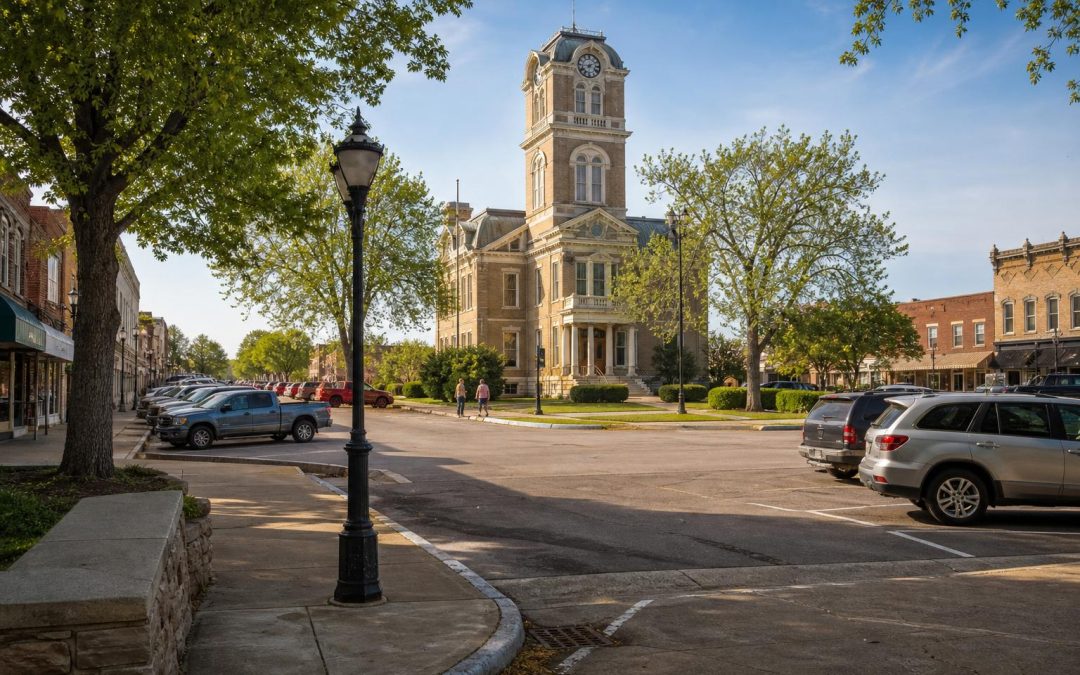
Pull into almost any Arkansas county seat and you will find some version of the same scene: a courthouse, a patch of lawn, a few monuments, and rows of buildings watching from across the street.
Most people glance at the courthouse first. That makes sense. It is usually the biggest building in town.
But here is what I recommend: look at the courthouse, then turn around.
The courthouse gives you the county’s official story. The buildings facing it tell you how the town actually worked. That is where people bought shoes, borrowed money, picked up medicine, consulted lawyers, watched movies, traded crops, and heard the latest news.
Once you learn to read those clues, an ordinary stop in an Arkansas town becomes a small history hunt.
Start at the Courthouse, Then Read the Town
Begin with the courthouse itself. Is it grand and decorative, or plain and practical? Does it sit in the middle of a square, on one side of it, or on a hill above town?
Those choices were rarely accidental.
A large courthouse often reflects a period when local leaders expected the county to grow. In places shaped by timber, cotton, railroads, coal, or oil, public buildings could become statements of confidence. The town was telling everyone who arrived, we plan to be here a while.
Now turn toward the surrounding blocks.
Look at the width of the buildings. Many old businesses occupied narrow lots because merchants needed access to the busy square more than they needed a wide front. The store might look small from the sidewalk but stretch surprisingly far toward the alley.
Then look up. Ground floors get remodeled. Upper floors are more honest.
Old windows, decorative brick, faded signs, and carved names can reveal what a storefront looked like before aluminum panels and modern signs covered it. In many Arkansas downtowns, the best details are one story above where everybody is looking.
Worth Noticing: Check the corner buildings first. Banks, drugstores, and hotels often wanted prominent corners where traffic from two streets met. A clipped corner or angled doorway was not just decoration. It helped pull customers inside.
Look for the Clues Most People Pass Without Noticing
The courthouse lawn is usually full of clues, but do not treat every monument as a complete history lesson. Notice what is remembered, when the marker was placed, and what stories are missing.
You may find military memorials, county founders, local officials, or plaques marking an earlier courthouse. Together they show how the community chose to describe itself at different times.
Walk the full block if you can. The back side of a square can be more revealing than the front.
- Alleys show how freight reached stores before delivery trucks had plenty of room.
- Different shades of brick may mark repairs, additions, or rebuilding after a fire.
- Blocked windows can reveal upper floors that once held offices, meeting rooms, or hotel rooms.
- Old painted advertisements sometimes survive on walls that were hidden by neighboring buildings.
- Changes in sidewalk height may show where streets were graded or entrances were altered.
Listen, too. On a weekday morning, a functioning square still has its old rhythm. Attorneys cross the street carrying files. County employees come and go. Somebody stops to talk longer than planned. A courthouse square is not merely an old setting. In many Arkansas towns, it remains the place where public business and everyday life bump into each other.
Roads, Railroads, Fires, and Floods Changed the Square
An Arkansas square makes more sense when you ask one question: How did people arrive here?
Some county seats grew along wagon roads. Others depended on rivers. Later, railroads pulled stores and hotels toward a depot, sometimes creating a second business district several blocks from the courthouse.
If Main Street seems to wander away from the square, follow it. It may be pointing toward an old depot site, river landing, mill, or highway route. What looks like an oddly shaped downtown may actually be a map of changing transportation.
Van Buren is especially good for seeing this connection. The Crawford County Courthouse anchors one end of Main Street, while the street drops toward the Arkansas River and the railroad. Stand near the courthouse and look downhill. Government, trade, transportation, and geography line up in one view.
Fire also reshaped many downtown blocks. Closely packed wooden buildings, heating stoves, and limited firefighting equipment were a dangerous combination. After a major fire, merchants often rebuilt with brick. That is why one side of a square may look unusually consistent while another side appears pieced together over time.
In the Delta, water belongs in the story. Towns near the White, Arkansas, Black, and Mississippi rivers lived with rich soil, river commerce, and repeated flooding. High foundations, levees, altered streets, and gaps where buildings disappeared can all tell part of that story.
Worth the Detour: Powhatan does not offer the classic busy commercial square, but its old courthouse above the Black River is one of Arkansas’s best places to understand why elevation mattered. The hill gave the courthouse presence, but it also placed important records and public business above the river’s reach. Once you see that landscape, the location makes perfect sense.
Some of My Favorite Squares for Learning to Look
If you want a courthouse square with an easygoing Ozark feel, start with Mountain View. The Stone County Courthouse sits at the center of a downtown where music, craft traditions, local business, and county life still overlap. Come when the square is active, but also walk it during a quieter hour. You will notice much more in the buildings.
Paris is my pick when someone wants a courthouse with real visual punch. The Logan County Courthouse rises over a handsome square that reflects the confidence of a community shaped by agriculture and the nearby coal fields. The building deserves a slow lap rather than a quick photograph.
Logan County also offers a useful Arkansas surprise: it has two county seats, Paris and Booneville. Several Arkansas counties divide court business between two towns. Carroll, Sebastian, Prairie, Yell, Clay, and Craighead are among the others. That arrangement tells you something important about difficult travel, regional loyalties, and the days when crossing a county could take real effort.
For a larger downtown experience, try El Dorado. The Union County Courthouse square feels different from a tiny Ozark county seat because El Dorado’s story includes the oil boom and the money, construction, and ambition that followed. Look beyond the courthouse at the size and detail of surrounding commercial buildings. This was a town built to handle serious business.
For Arkansas history packed into a walkable setting, I always recommend Historic Washington State Park. The old Hempstead County Courthouse and surrounding streets help explain how an important town developed along the Southwest Trail. Washington is less about watching a modern county seat at work and more about stepping into an earlier Arkansas street pattern. Give it extra time.
Build a Courthouse Square Road Trip Worth Slowing Down For
Do not try to collect courthouse photographs through the windshield. Pick a region and connect three or four towns.
In the Ozarks, combine Mountain View with Batesville or Melbourne. In western Arkansas, pair Paris with Booneville, Greenwood, or Van Buren. In southern Arkansas, compare El Dorado with Magnolia, Hamburg, or Monticello. Each grouping shows how neighboring towns could develop very different personalities.
My Pick: If you only have time for one square, choose the place closest to home and spend thirty minutes walking it. Familiar towns are often the most surprising because we have trained ourselves not to look closely.
Park once. Circle the courthouse. Read the building tops. Peek down the alleys. Notice where the main road enters and where it goes next.
Then ask yourself why this town is here.
That question changes everything. The square stops being a collection of old buildings and becomes a record of Arkansas people adapting to rivers, ridges, railroads, fires, crops, industries, and one another.
And the next time you pass through a county seat, you may find yourself pulling over.
You should. There is almost always something worth noticing.