
Here is a better way to choose an Arkansas state park with your family: start with a mystery instead of a map.
Do you want to know why diamonds ended up near Murfreesboro? How people built a major gathering place beside an Arkansas bayou centuries ago? Why water pours from the ground at Mammoth Spring? Why the Delta has lakes shaped like giant bends?
Once children have a question to chase, a park stops feeling like an outdoor classroom assignment. It becomes a place where the clues are hiding in dirt, rocks, trees, buildings, and water.
That is one of my favorite things about exploring Arkansas. Our state parks are not separate attractions. Together, they explain why Arkansas changes so dramatically as you cross it.
Start With the Story Your Family Wants to Uncover
If your family likes to touch, dig, climb, watch, and investigate, choose a park where the landscape itself provides the lesson.
- For digging and geology: Crater of Diamonds
- For ancient Arkansas: Plum Bayou Mounds
- For frontier life: Historic Washington
- For caves and rock formations: Devil’s Den
- For wetlands and wildlife: Lake Chicot
- For mountain ecology: Mount Magazine
- For underground water: Mammoth Spring
- For oil and Arkansas industry: Arkansas Museum of Natural Resources
You could visit any one of these and have a good day. The trick is knowing what to notice when you arrive.
The Best Arkansas State Parks for Hands On Learning
Crater of Diamonds State Park
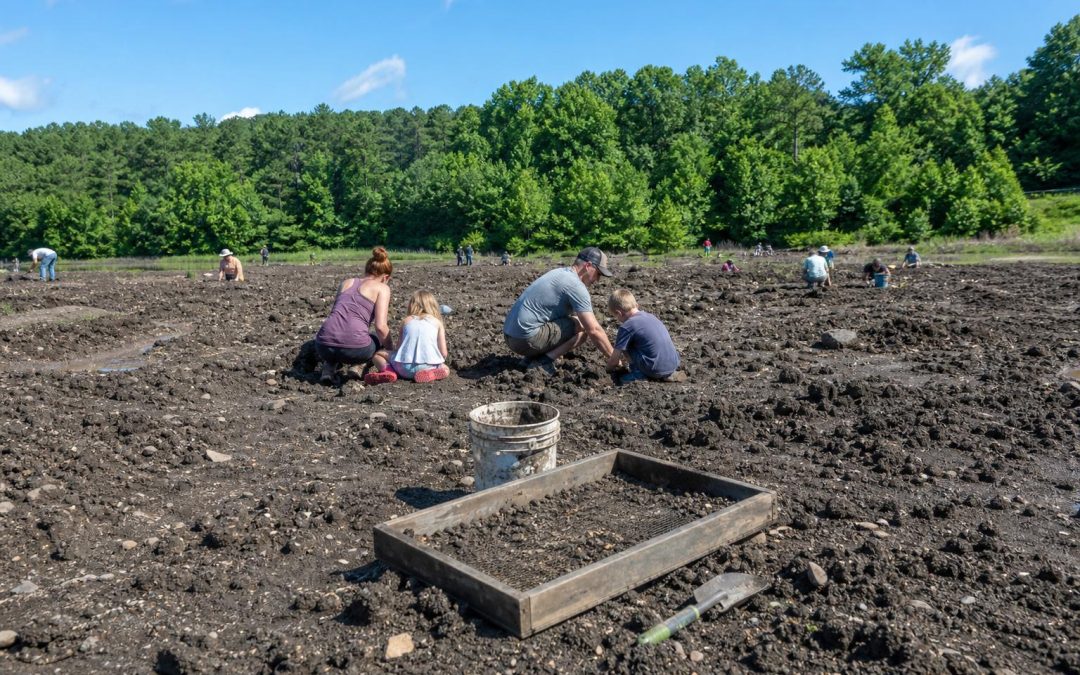
This is the obvious family pick, but it deserves its reputation. Near Murfreesboro, you can search a plowed volcanic field for real diamonds and keep what you find.
The diamond is exciting. The larger discovery is that this ordinary looking patch of southwest Arkansas is the eroded top of an ancient volcanic pipe. Look closely at the gravel and you may also find jasper, quartz, calcite, and other rocks that would be easy to walk past anywhere else.
My Pick: Begin at the visitor center before digging. Knowing what the common minerals look like makes the field much more interesting. Tool rentals are available, but patient eyes matter more than elaborate equipment.
Plum Bayou Mounds Archeological State Park
Near Scott, the largest mound complex in Arkansas sits quietly among fields and water. That peaceful setting can hide what made this place important.
The Plum Bayou people moved enormous amounts of soil by hand to create a ceremonial and community center. As you walk, notice how the mounds relate to one another rather than treating each one as an isolated hill. The open spaces were part of the plan too.
This park is especially good for children who think Arkansas history began with log cabins. It gently pushes the story much farther back.
Worth Noticing: The surrounding flat Delta landscape makes the mounds stand out. Their height, shape, and placement were intentional.
Historic Washington State Park
Historic Washington feels less like visiting one old building and more like stepping into an Arkansas town while it is still telling its story.
Washington grew along the Southwest Trail, a busy route carrying travelers, news, goods, and ideas through the region. Walk between the courthouse, homes, workshops, and tavern, and the town begins to make sense as a connected place.
Check the interpretive schedule for demonstrations. A working forge or craft demonstration can explain frontier life faster than a room full of labels.
Slow Down Here: Pay attention to the distance between buildings. Walking was part of everyday life, and the town’s layout tells you who needed to be near whom.
Devil’s Den State Park
Devil’s Den is where the Boston Mountains turn geology into an adventure. Trails lead past sandstone bluffs, narrow crevices, caves, and weathered rock shelters.
Ask how water, gravity, and time could pull apart such solid looking rock. Then notice how cooler air and moisture around the crevices change the plants nearby.
The park also has some of Arkansas’s best Civilian Conservation Corps stonework. The cabins, dam, and other structures look like they grew from the valley because builders used local materials so well.
Good to Know: Cave access may be restricted to protect bats from disease. Check current park guidance and never enter a closed cave. The trails and crevices still reveal plenty of the story.
Lake Chicot State Park
Lake Chicot offers a completely different Arkansas lesson. This long, curved lake is an old channel left behind by the Mississippi River.
Once you know that, its shape becomes the clue. The cypress trees, muddy banks, birds, and broad Delta sky all belong to a landscape built and repeatedly rearranged by water.
Bring binoculars if you have them. Children who are not excited by a long walk will often spend surprising amounts of time watching egrets, herons, woodpeckers, and movement along the shoreline.
Mount Magazine State Park
At 2,753 feet, Mount Magazine is Arkansas’s highest point, but the elevation marker should not be the only goal.
The real lesson is how quickly conditions change as you climb. Temperature, wind, soil, and exposure create different habitats on the mountain. Watch for changes in trees and wildflowers, then compare a sheltered forest with an open overlook.
If You Are Short on Time: Walk to Signal Hill for the high point, but save time for an overlook. Signal Hill proves where you are. The overlooks help you understand why the mountain matters.
Mammoth Spring State Park
At Mammoth Spring, a huge volume of clear water appears from underground and forms the beginning of the Spring River. It is one of those places that makes children ask exactly the right question: where was all that water a minute ago?
The answer leads beneath the Ozarks, where water moves through cracks and passages in soluble rock. The old hydroelectric plant adds another layer by showing how Arkansans put that steady flow to work.
Arkansas Museum of Natural Resources
Near Smackover, this park explains why wooden derricks once crowded the south Arkansas skyline.
The oil boom changed towns, jobs, transportation, and daily life. Outdoor equipment and indoor exhibits help families connect a substance underground with the communities that sprang up above it. It is an excellent rainy day choice and one of the best places to understand that Arkansas history is also industrial history.
What Most Families Walk Right Past
At every park, look for the ordinary detail that explains the whole place.
- At Crater of Diamonds, examine the rocks nobody keeps.
- At Plum Bayou Mounds, study the empty spaces between mounds.
- At Historic Washington, notice why buildings face the road.
- At Devil’s Den, compare CCC stonework with the surrounding cliffs.
- At Lake Chicot, trace the lake’s curve and imagine the old river.
- At Mount Magazine, watch the plants change with elevation.
- At Mammoth Spring, follow the water from spring to river.
Those are the details that turn a pleasant outing into an Arkansas discovery.
Turn One Park Visit Into a Family Adventure
Do not try to learn everything. Pick one question before you arrive, let every family member find one clue, and compare answers before leaving.
Also, check the park calendar. Guided walks, demonstrations, wildlife programs, and interpreter led activities can completely change a visit.
If I were choosing a first educational adventure, I would pick Crater of Diamonds for active children, Historic Washington for families who enjoy stories, and Plum Bayou Mounds for the biggest surprise.
But whichever park you choose, give it time. Arkansas reveals itself slowly. Sometimes the most memorable discovery is not a diamond, a mountaintop, or a historic building. It is the moment someone looks at an ordinary patch of Arkansas and realizes there is a very good reason it looks that way.