
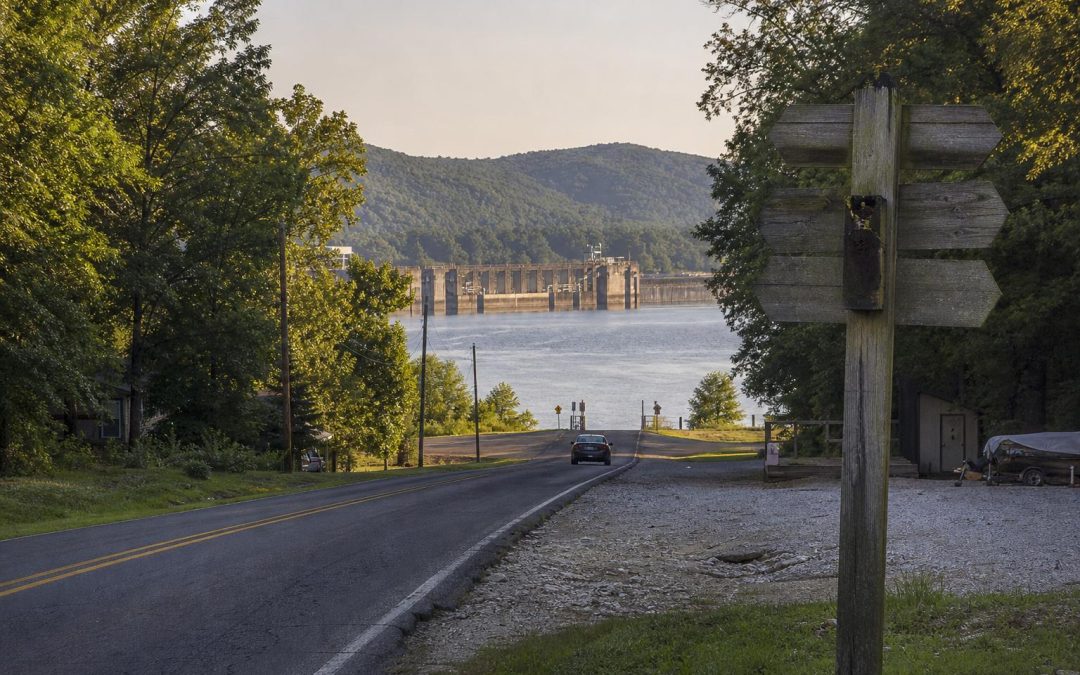
An Arkansas road sign can be a tiny history marker. The trouble is, it rarely has room to tell you the history.
You pass names like Toad Suck, Smackover, Evening Shade, Oil Trough, and Possum Grape. You smile, wonder about them for a mile or two, and keep driving. But once you start asking why those names are there, an ordinary Arkansas drive changes.
Place names are not just labels. They are instructions for what to notice.
A name might point to a vanished prairie, an old salt spring, a river crossing, a family that arrived early, or somebody’s ambitious plan for a new town. Some preserve words spoken here long before Arkansas became a state. Others preserve stories that may have grown a little taller with every retelling.
That is what makes them fun. The map starts talking back.
Start With the Signs That Make You Ask Why
Toad Suck is the obvious place to begin. The community sits along the Arkansas River west of Conway, and several stories compete to explain the name. The best known involves riverboat crews stopping at a tavern and drinking until they supposedly swelled like toads. It is colorful, memorable, and not especially easy to prove.
That uncertainty is part of the experience. Arkansas place name stories are often a mixture of records, local memory, pronunciation changes, and good storytelling. You do not have to solve every mystery to enjoy it.
Worth the Detour: If you are near Conway, drive out to Toad Suck Park and look at the river. The name makes more sense when you remember that this was a working river corridor, not merely an amusing sign beside a highway.
Smackover offers another irresistible name. Its origin is usually connected to the French phrase chemin couvert, describing a covered or wooded path. English speakers gradually reshaped the sound into something much more Arkansan.
Then oil transformed Smackover in the 1920s. Today, the Arkansas Museum of Natural Resources helps connect that funny sounding name to one of the biggest industrial stories in the state. This is exactly the kind of stop I recommend. You arrive because the name caught your attention, then discover why the whole region mattered.
The Landscape Is Hiding Inside the Names
Now look at names that seem ordinary: Prairie County, Walnut Ridge, Mountain View, Mountain Home, Hot Springs, and Cotton Plant.
They are easy to overlook because they sound so straightforward. Yet each one tells you what earlier residents noticed or what they wanted other people to notice.
Prairie County is especially revealing. Much of eastern Arkansas is farm country today, but the county name remembers the open Grand Prairie landscape that existed before rice fields, reservoirs, roads, and towns changed the view. When you drive through that country, do not see it as simply flat. Watch for the huge sky, long horizon, irrigation canals, and flocks of waterfowl. The old prairie still helps explain why the region feels different from the wooded Delta nearby.
Walnut Ridge points toward the higher ground of Crowley’s Ridge. That ridge is not just a wrinkle on the map. It rises above the surrounding Delta and has influenced where people built roads, farms, and communities. Once you notice the change in elevation and trees, the name becomes wonderfully literal.
Cotton Plant records the crop that shaped the community. Stuttgart, although named for a German city, is now tied closely to rice, ducks, and the Grand Prairie. Names and landscapes do not always tell the same chapter of the story. That is another detail worth watching for.
Earlier Languages Are Still on the Map
Arkansas itself carries the influence of Native languages and French spelling. The name came through French usage from a word associated with the Quapaw people. That French influence helps explain why we do not pronounce the final s.
Names such as Quapaw, Osage, Caddo, and Ouachita remind us that Arkansas history did not begin with county courthouses and railroad depots. These names survived even as languages were filtered through French and English speakers, spelling shifted, and original meanings became harder to pin down.
That is why neat explanations deserve a little caution. A place name may be ancient without offering us one tidy translation.
Good to Know: Ouachita is commonly pronounced “WAH shi taw.” If you wait for the spelling to help, you may be waiting a while.
Some Towns Were Named With Hope, Homesickness, or Humor
Arkansas is full of borrowed names. We have Paris, London, Hamburg, Stuttgart, Melbourne, Palestine, and Damascus. These names often reflect settlers’ former homes, cultural connections, or hopes that a young community might grow into something important.
Paris is one of my favorite examples because the community enjoys the connection rather than pretending it is accidental. There is even an Eiffel Tower replica near the courthouse square. It is playful, but the surrounding Arkansas River Valley and the nearby climb toward Mount Magazine make this Paris entirely its own.
Hope was named for the daughter of a railroad official. Texarkana combined Texas, Arkansas, and Louisiana into one confident name, even though Louisiana is not actually part of the city. Eureka Springs advertised the excitement surrounding its springs. Mountain View and Mountain Home offered equally appealing pictures of life in the Ozarks.
Then there are names that simply make a map more cheerful: Romance, Evening Shade, Blue Eye, Turkey Scratch, and Goobertown.
I would not build an entire trip around getting a photograph of every funny sign. That can turn Arkansas into a scavenger hunt and cause you to miss the places themselves. Stop long enough to look around. Ask why a settlement formed there. Notice the creek, railroad, ridge, farmland, or old commercial buildings nearby.
There is usually a good reason the name stayed put.
Build a Place Name Road Trip
You can try this almost anywhere in Arkansas, but I would choose one region rather than race across the state.
- For river names and local legends: Start around Conway and Toad Suck, continue to Petit Jean Mountain, then follow the Arkansas River toward Dardanelle and Paris.
- For oil, railroads, and big ambitions: Visit Smackover and El Dorado, then continue toward Hope and Texarkana.
- For landscapes hidden in names: Explore Stuttgart, Prairie County, Cotton Plant, Walnut Ridge, and Crowley’s Ridge.
- For wonderfully unusual signs: Look for Evening Shade, Oil Trough, Possum Grape, Romance, and Fifty Six, but pair them with nearby parks, museums, town squares, and scenic roads.
My Pick: The Conway, Petit Jean, Dardanelle, Paris, and Mount Magazine route gives you the best mixture of river history, local legend, small towns, and dramatic scenery. Do not rush it. Petit Jean deserves several hours, and Mount Magazine is worth the extra drive.
Ask a Local Before Trusting the Spelling
Arkansas pronunciation is part of the adventure. Petit Jean is “Petty Jean.” El Dorado is usually “El duh RAY doh.” Stuttgart begins more like “Stoot” than “Stutt.” Nevada County is commonly said “nuh VAY duh.”
If you say one differently, someone will probably help you. That is not a disaster. It is a conversation starter.
The best place name trips are built on curiosity rather than collecting trivia. Read the signs. Say the names aloud. Look at the land around them. Ask questions in a diner, museum, visitor center, or courthouse square.
Arkansas becomes much more interesting when you realize the road signs are telling you where to look.