
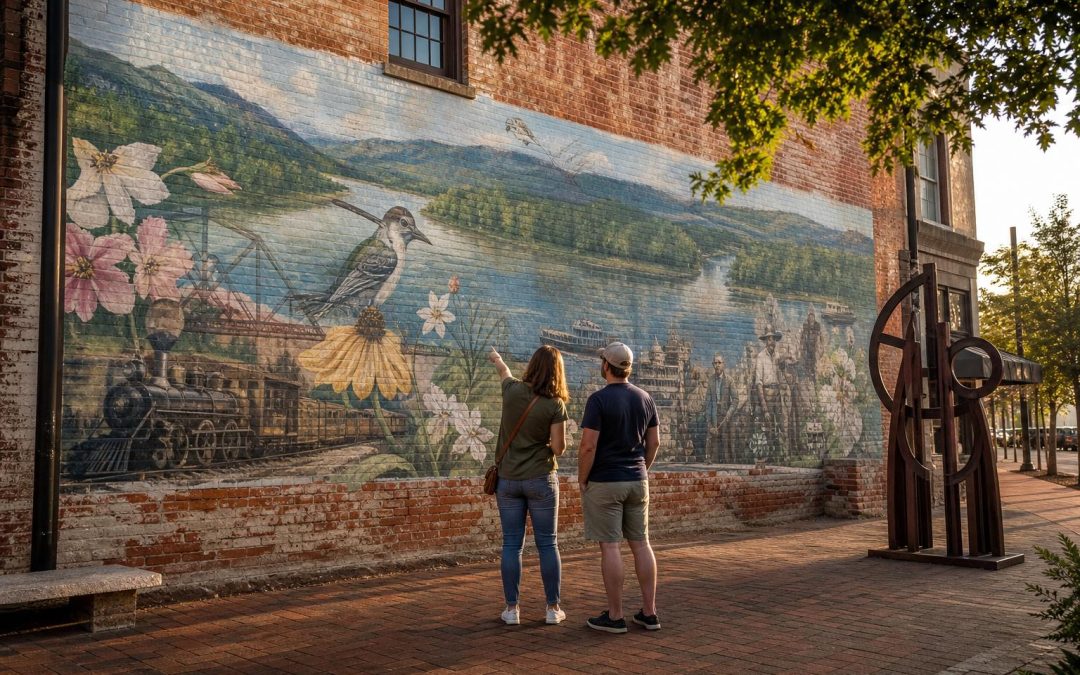
A mural is rarely just a pretty wall in Arkansas.
Look closely and you may find cotton fields, railroad tracks, bathhouse windows, Delta blues, Ozark wildlife, bicycle wheels, or the face of somebody whose story deserves to be remembered. Even the wall itself can tell you something. An old warehouse, grain elevator, storefront, or retaining wall was chosen for a reason.
That is the trick to enjoying public art here. Treat each piece as a clue to the community around it. The photograph is nice, but the real reward comes when the artwork sends you looking down the next block, reading a nearby marker, or wondering why this particular image belongs in this particular Arkansas town.
Start With the Artwork That Makes You Ask Why It Is There
The most interesting public art often creates a little confusion. Why is there a giant painted figure on the side of a Fort Smith building? Why are sculptures scattered beside the Arkansas River in Little Rock? Why does a downtown mural in Pine Bluff show scenes that seem connected to farming, music, business, and Black history?
Do not rush past that question. It is the beginning of the experience.
Fort Smith is one of my favorite places to practice this kind of looking. The murals created through The Unexpected turned large downtown walls into bold works of art, but their setting matters just as much as their color. Fort Smith grew as a river town, military outpost, federal court center, and transportation hub. Its brick buildings carry that heavy history. Contemporary artwork on those walls creates a fascinating conversation between the old city and the one still being built.
Walk across the street before taking your picture. Notice the size of the building, the faded brick, nearby railroad features, and the distance to the river. Suddenly, the mural is not floating by itself. It belongs to Fort Smith.
Worth Noticing: Many Arkansas murals use walls that once advertised stores, feed, paint, groceries, or farm products. Look for old lettering around the newer artwork. Sometimes one wall holds several generations of Arkansas business history.
Look Closer for the Arkansas Stories Hiding in the Details
Arkansas artists have an enormous visual vocabulary to work with. We have rice fields and mountain ridges, paddlefish and elk, courthouse squares, musical traditions, military history, civil rights landmarks, hot springs, timber towns, and rivers that shaped where communities could grow.
When you find a mural, mosaic, or sculpture, start with a few simple questions:
- Which plants, animals, crops, or landforms appear in it?
- Does it show a local industry such as timber, rice, railroads, poultry, mining, or river trade?
- Are the people named, or were they chosen to represent a larger community?
- Does the artwork point toward a nearby building, neighborhood, trail, or historic event?
- What changes when you view it from across the street instead of directly in front of it?
Pine Bluff is especially rewarding when you want art to lead you into local history. Downtown murals help reveal the city as more than a stop along the highway. They point toward the Arkansas Delta, the importance of the river and railroads, generations of Black achievement, and the businesses that once filled the surrounding blocks.
Here is what many visitors miss: the empty spaces around a mural can be part of the story. A quiet lot or worn storefront may show how much a downtown has changed. Public art does not always cover that up. Sometimes it asks us to pay attention to it.
In Hot Springs, look for artwork connected to bathing culture, baseball, music, and Black history. Then compare those images with the city itself. The tiled storefronts, old hotels, steep hills, and bathhouses give the art context. A baseball themed piece becomes more interesting once you know that major league players came here for spring training. An image tied to bathing makes more sense when warm water is still flowing from the mountain nearby.
Turn One Mural or Sculpture Into a Walk Through the Community
This is my strongest recommendation: never make the artwork your only stop. Give it at least one block in every direction.
In Little Rock, the sculptures in Riverfront Park belong to a landscape shaped by the Arkansas River, bridges, trails, flood concerns, and the meeting of two cities. Walk through the Vogel Schwartz Sculpture Garden, but keep looking beyond the individual pieces. Watch cyclists pass. Notice the bridges overhead. Look toward North Little Rock. The setting explains why this public space feels active rather than sealed off like a gallery.
If you want public art with deeper historical weight, continue toward the grounds of the Arkansas State Capitol and the Testament monument honoring the Little Rock Nine. The figures are positioned so visitors can stand among them rather than merely look from a distance. That choice matters. It turns a nationally known civil rights story back into something personal, human, and rooted in an Arkansas place.
Bentonville offers a different experience. Public art there often shares space with bicycle routes, renovated commercial buildings, new gathering places, and the outdoor art around major cultural institutions. The result says a great deal about what the city values now. Follow art from downtown toward The Momentary or the Crystal Bridges grounds and you will see how trails, architecture, and artwork have been woven together.
My Pick: For a relaxed first public art outing, choose a compact downtown such as Fort Smith, Bentonville, or Pine Bluff. Park once, walk slowly, and let one piece lead to another. You will notice far more than you would while driving from mural to mural.
Build a Public Art Day Trip With Room for Surprises
A good Arkansas public art day does not need twelve scheduled stops. Three or four strong locations are plenty, especially if you leave time for a courthouse square, local restaurant, river walk, or unexpected painted alley.
I would build the day like this:
- Begin downtown in the morning. The light is often better for large walls, streets are quieter, and you can study the setting without dodging as much traffic.
- Choose one major piece as your anchor. Learn what it represents, then walk the surrounding blocks looking for connections.
- Add a different kind of artwork. Pair murals with sculpture, mosaics, memorials, utility box art, or an installation along a trail.
- Eat nearby. Public art makes more sense when you also experience the community supporting it.
- Finish somewhere you can wander. A riverfront, college campus, downtown square, or cultural district gives chance discoveries room to happen.
For variety, Fort Smith gives you huge walls and a strong historic setting. Little Rock offers sculpture, memorials, and riverfront spaces. Bentonville connects art with trails and a rapidly changing city. Pine Bluff rewards visitors willing to slow down and read the Delta stories around them. Hot Springs layers artwork onto one of the most unusual landscapes and histories in the state.
Good to Know: Public art changes. Walls are repainted, buildings change owners, and temporary installations disappear. Check a local arts council, city public art map, or downtown organization before making a long drive for one specific piece.
Most of all, resist the urge to collect photographs and move on. Stand back. Find the old brick under the paint. Look for the river, railroad, ridge, crop, person, or neighborhood hidden in the design.
Arkansas public art is not decoration added after the story. At its best, it is a doorway into the story that was already there.