
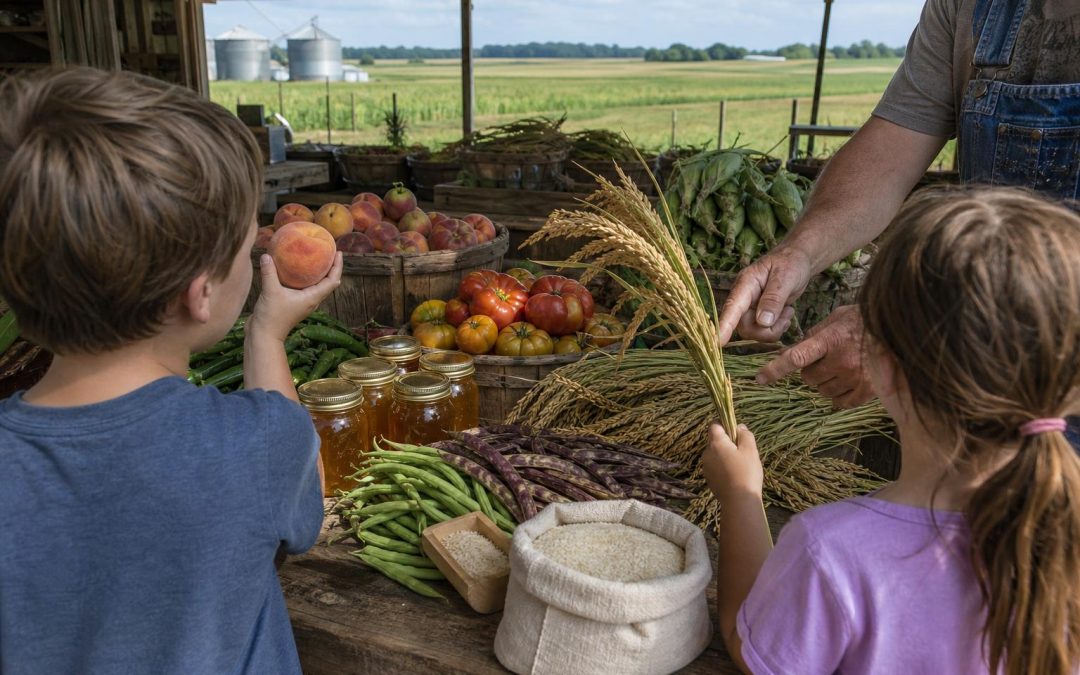
Hand a child a peach at an Arkansas farmers market and ask one simple question:
Where in Arkansas did this come from?
Not which basket. Not which table. Which part of Arkansas?
That question can turn an ordinary Saturday morning into a trip across the state. A peach may lead you toward the orchards around Johnson County. A bag of rice points toward the flat fields of the Delta and Grand Prairie. A watermelon might have a story connected to Cave City, Hope, or another Arkansas community where hot summers and good soil produce something worth bragging about.
That is the big idea I want children to notice: a farmers market is a map of Arkansas that you can taste.
Start With the Place, Not the Price
Most of us arrive at a market thinking about what looks good and what we need for supper. That is perfectly reasonable. But before filling your bag, slow down and look for place names.
You may see a farm name on a banner, a town printed on a jar, or a county listed on a small sign. If you do not see one, ask.
“What town did these come from?” is one of the best questions a child can ask a farmer. It is easy to answer, and it often opens the door to a much better conversation.
The answer matters because Arkansas does not grow everything in the same kind of landscape. The Delta is broad and flat, with rich ground suited to crops including rice, soybeans, and cotton. The Ozarks have hills, rocky soil, forests, small farms, and orchards. The Arkansas River Valley has its own mix of farms, vineyards, gardens, and pasture. South Arkansas brings longer growing seasons, sandy soils in places, timber country, and serious tomato and watermelon traditions.
A tomato is no longer just a tomato once you know the road it traveled.
Let the Stalls Show You an Arkansas Season
Here is something children often find surprising: a real farmers market should change.
If every visit looks exactly the same from April through October, you are missing one of the most interesting parts. Arkansas weather writes the shopping list.
Spring Feels Tender
Early markets may have lettuce, green onions, radishes, herbs, eggs, and strawberries. Spring produce often looks delicate because it grew during cooler days before an Arkansas summer started turning every parked car into an oven.
Ask which crop can handle a late cold snap and which one makes farmers watch the forecast nervously. That question introduces children to the risk behind every pretty basket.
Summer Starts Showing Off
This is the season of tomatoes, peaches, blackberries, squash, cucumbers, sweet corn, okra, peas, peppers, and melons. The tables become brighter, heavier, and a little messier.
I would spend extra time with tomatoes. Arkansas has a deep tomato tradition, especially around Bradley County and the famous pink tomato culture of South Arkansas. Look at the shapes. Smell the stem end. Ask which variety the farmer would slice for a sandwich and which one belongs in sauce.
Then find a peach or melon and ask why that particular community is known for it. Children begin to understand that farming fame is not random. Soil, rainfall, heat, local knowledge, and generations of seed saving and experimentation all play a part.
Fall Gets Sturdy
As the weather cools, look for sweet potatoes, pumpkins, winter squash, apples, pecans, greens, rice products, and late peppers. These foods feel different from spring strawberries because many can be stored.
That gives you another good question: Which foods had to be eaten quickly, and which ones helped Arkansas families through winter?
Jars matter here too. Pickles, salsa, jam, jelly, and preserves are more than treats. They show how people saved a season before a grocery store could supply the same produce all year.
Try a Scavenger Hunt Farmers Will Actually Enjoy
Skip the worksheet with twenty tiny boxes. Give each child four or five things to discover, then let the market provide the surprises.
- Find something grown in your county or a neighboring county.
- Find a food connected to the Arkansas Delta, Ozarks, River Valley, or South Arkansas.
- Ask a farmer which crop is hardest to grow.
- Find something that depends on bees or other pollinators.
- Find one fresh food and one preserved version of an Arkansas crop.
- Ask what will appear at the market next month.
That last question is my favorite. It turns one visit into a reason to return.
Be considerate about timing. If six customers are waiting to pay, that is not the moment for a long interview about soil. Buy something, step aside, and return when the table is quieter. A sincere child with one good question will usually get a warmer response than an adult conducting a full investigation.
Do Not Miss the Honey Table
If there is a local beekeeper, stop.
Honey is one of the best ways to explain that farms do not end at the fence. Bees move through gardens, orchards, clover, wildflowers, and woods. Ask where the hives sit and what was blooming when the honey was gathered.
Children may expect all honey to taste alike. It does not. Color and flavor can shift with location and season. That jar is connected to thousands of tiny flights across a real Arkansas landscape.
Now the market map includes flowers nobody came to buy.
Take One Arkansas Ingredient Home
Do not end the lesson in the parking lot. Choose one ingredient and follow its story into the kitchen.
If you buy Arkansas rice, find the farm or mill on a map and talk about why rice fields fit the level ground of eastern Arkansas. Then cook it and notice how much the grains change.
If you choose tomatoes, taste two varieties side by side with a little salt. If you bring home peaches, cut one open and look at the pit, juice, skin, and flesh before making anything. With honey, compare a spoonful to ordinary white sugar and talk about the work required to produce each one.
Keep the recipe simple. A tomato sandwich, bowl of rice, peach with yogurt, or skillet of squash leaves room to pay attention to the ingredient itself.
An Arkansas farmers market can teach geography, weather, biology, history, cooking, and economics before lunch. More importantly, it helps children see farms as real places worked by real neighbors.
So go for the tomatoes. Go for the peaches. Go because a warm biscuit deserves local honey.
But while you are there, ask where everything came from. Arkansas will start unfolding one table at a time.