
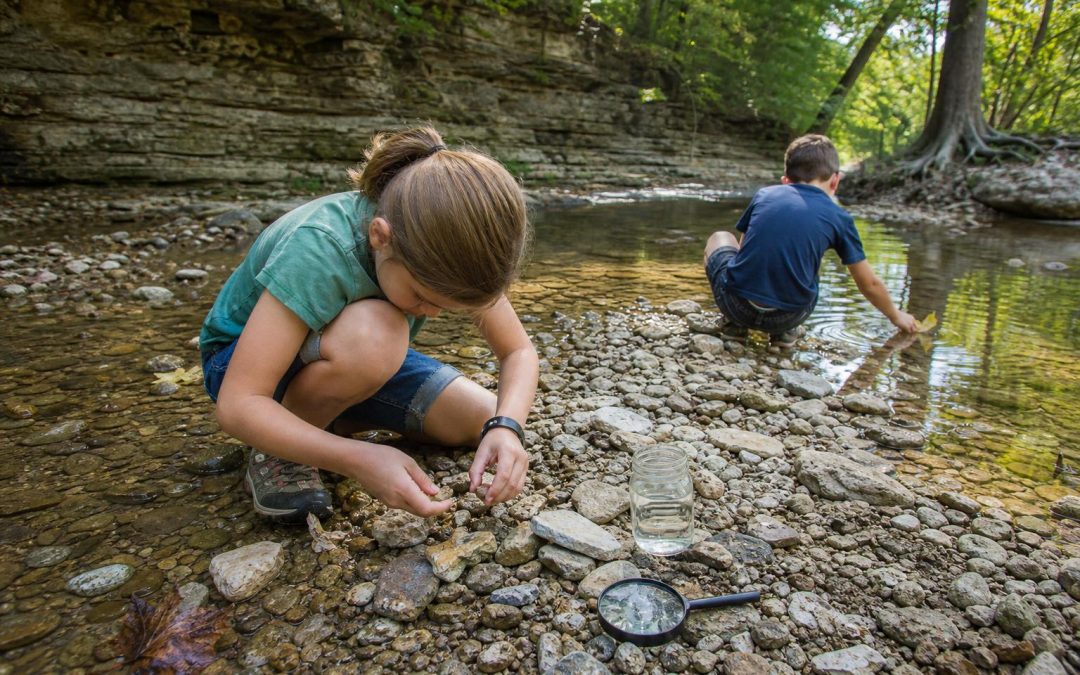
Walk onto an Arkansas gravel bar and ask one question before anybody gets wet:
What did this creek carry here?
That question changes the whole outing. Suddenly, the flat gray stone is not just a rock. The tiny fossil is not just a funny mark. Even the neat rows of pebbles along the waterline become clues.
Here is the idea I want kids to remember: an Arkansas gravel bar is a map of the country upstream, rearranged by water. Every flood edits it. Every current sorts it. Every stone has traveled some distance, even if that distance was only around the next bend.
You do not need a geology degree, a rock hammer, or a bucket for hauling treasures home. You just need wet shoes, curious eyes, and enough time to look closely.
Start With the Mystery Upstream
Arkansas is especially good for this kind of adventure because our creeks cross wonderfully different landscapes.
In the Ozarks, a creek may carry pale limestone, rough chert, and pieces of dolomite. Some rocks may hold fossils from the shallow seas that covered this part of Arkansas long before there were hills, roads, or children hunting crawdads.
Travel south into the Ouachitas and the evidence changes. There you are more likely to notice sandstone, shale, milky quartz, and hard novaculite. Novaculite is the stone connected to Arkansas whetstones, and it is one reason Hot Springs and the surrounding mountains have such an interesting rock story.
Worth Noticing: The creek is showing you more than what sits beneath your feet. It is delivering samples from places you cannot see around bends, beneath bluffs, and farther up the hollow.
Ask everyone to look upstream. Is the valley narrow or broad? Are there bluffs nearby? Does the creek run out of wooded hills or flatter farm country? The rocks begin making more sense once you notice the land carrying the water.
Read the Gravel Bar Like a Detective
Most people head straight for the water. I recommend spending five minutes on the dry gravel first.
Look at the biggest stones. Then find the smallest patch of sand. Water usually drops heavier material when it loses energy, while fine sand and silt settle in quieter spots. A gravel bar is not a random pile. It is the creek showing where the current sped up, slowed down, curled behind an obstacle, or spread across the channel.
Now look at shape.
A sharp edged piece may have broken loose fairly recently or traveled only a short way. A smooth, rounded pebble has probably spent more time bumping, rolling, and scraping against other stones. That does not necessarily make it older. It tells you more about its journey.
Flat rocks offer another clue. You may find them overlapping like shingles, especially where strong water has pushed them into place. Their position can help you picture the direction of a past current, even if today’s creek barely reaches your ankles.
This is one of my favorite Arkansas creek surprises. The quiet gravel beneath your feet may have been built by water far stronger than anything you see that day.
Look for Fossils Without Expecting a Dinosaur
Arkansas creek fossils are usually small, and that is part of the fun. You are not hunting giant bones. You are looking for patterns that do not seem accidental.
In Ozark limestone, watch for little disks that resemble tiny washers or stacked beads. These may be pieces of crinoid stems. Crinoids were sea animals, though they looked a bit like flowers growing on stalks. Ribbed shell shapes may be brachiopods, another common clue to Arkansas’s ancient marine past.
You may also see branching or lacy textures in a rock. Those can be fossil remains, mineral patterns, or simply the way the stone weathered. It is perfectly fine not to know. A good detective says, “That is interesting,” takes a photograph, and keeps looking.
For Families: Bring a small magnifying glass. It can turn a dull looking rock into the most inspected object in the county.
Try Four Creekside Investigations
1. Build a rock journey line
Choose five loose stones close to the water. Without carrying them away, arrange them from sharpest to roundest. Ask which one seems to have done the most tumbling.
Then return every stone where you found it. The goal is not to reach a perfect answer. It is to start seeing shape as evidence.
2. Find the creek’s sorting bins
Search for three patches: large gravel, small gravel, and sand. Notice where each one appears in relation to bends, logs, roots, and shallow water.
Kids quickly discover that the creek has been sorting material by size without anybody telling it to.
3. Race two leaves
Choose two fallen leaves already beside the creek and release them at the same point. Watch which current catches them. One may hurry through the main flow while the other spins in a quiet pocket behind a rock.
Retrieve them if you can do so safely. More importantly, notice that water in one channel can move in several directions at once.
4. Make a fossil photo collection
Instead of filling pockets, photograph every possible fossil or unusual pattern. Place a finger beside it for scale. At home, compare the pictures with Arkansas fossil guides or resources from the Arkansas Geological Survey.
A photo collection has a major advantage: nobody has to remember which child claimed which rock.
Choose an Arkansas Creek That Rewards Curiosity
For an easy family introduction, Lee Creek at Devil’s Den State Park is one of my picks. The park gives you trails, restrooms, and plenty of surrounding geology to discuss. Stay in open public areas, obey park signs, and remember that rocks and other natural objects should remain in the park.
North Sylamore Creek near Blanchard Springs offers a strong Ozark setting with clear water, limestone country, and plenty of reasons to look closely. The spring water can be surprisingly cold, even when the Arkansas air says summer.
If your family already enjoys rougher country, the Cossatot River reveals the Ouachitas in a completely different way. Visit the state park natural area and admire how hard rock shapes the channel. I would not choose its rapids for casual wading. Low, calm edges are for investigating. Fast water is for respecting.
Always use an established public access point. A pretty bridge does not automatically make the land beside it public, and crossing fences to reach a creek is not part of the adventure.
Pack for Wet Feet and Changing Water
- Wear closed toe water shoes with good grip.
- Bring drinking water, sunscreen, insect repellent, and a change of clothes.
- Carry a magnifying glass and a phone or camera for photographs.
- Check the weather across the watershed, not just where you plan to stand.
- Skip the creek if the water is muddy, rising, or moving faster than expected.
Arkansas creeks can rise quickly after rain upstream. Never enter floodwater, avoid slippery ledges, and keep children close. Clear water can still be strong, cold, and deeper than it looks.
My best advice: Do not measure success by how many rocks you identify. Measure it by how many new questions everyone asks.
Leave the fossils, quartz, shells, and interesting stones where they belong, especially in state parks, national park sites, natural areas, and other protected places. Take photographs and notes instead.
That way, the next family gets to find the same clue and say exactly what you did:
“Come here. You’ve got to see this.”