
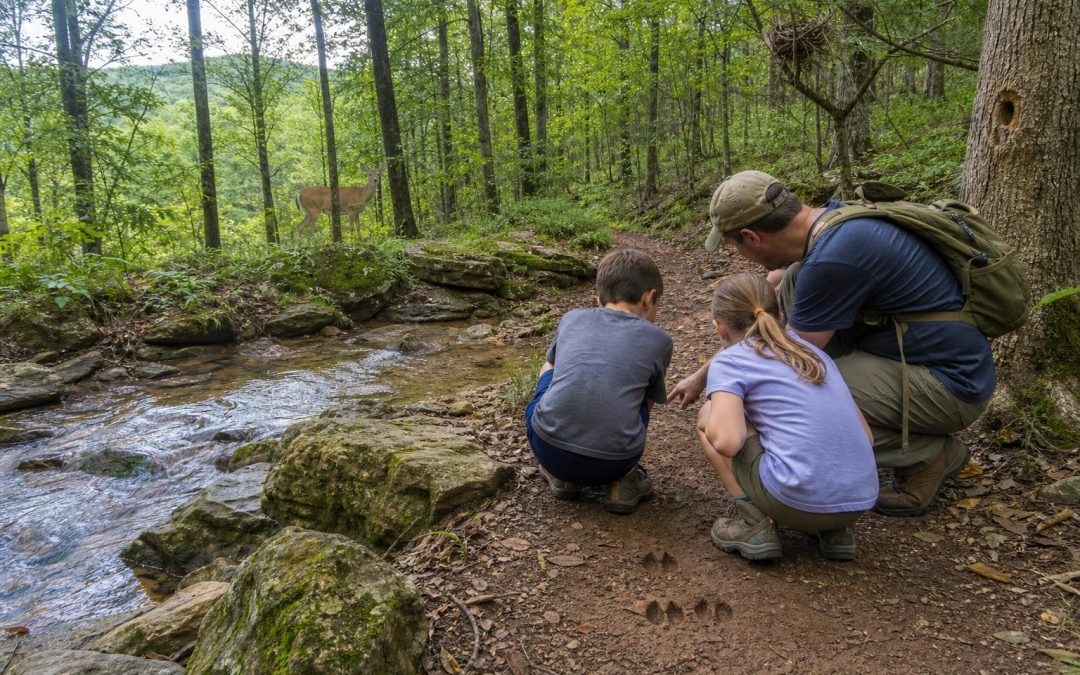
You do not have to spot a black bear to have a good Arkansas wildlife day.
In fact, the animal itself is often the last clue in the story. Before you ever see it, you may find tracks pressed into creek mud, bark peeled from a tree, feathers beside a trail, or a hole dug into somebody’s otherwise respectable lawn.
That is the trick I would teach kids first: do not just look for animals. Look for what animals have been doing.
Once children learn that, an ordinary walk beside an Arkansas pond becomes a treasure hunt. The woods are no longer empty. They are full of neighbors who stepped away five minutes before you arrived.
Start With the Wildlife Already Hiding in Plain Sight
Begin close to home. Arkansas backyards, city parks, school grounds, and neighborhood creeks hold more wildlife clues than most families realize.
Look beneath oak trees for acorn shells with tooth marks. Squirrels often leave a messy little dining room below a favorite branch. Scan dead trees for holes. Small round openings may belong to woodpeckers, while the pileated woodpecker can carve a much larger oblong hole while hunting ants.
You may hear that bird before seeing it. Its loud call sounds almost tropical, and its red crest makes it look like it has somewhere important to be. If a huge black woodpecker sweeps through the trees in a rolling flight, kids will remember it.
At the edge of a pond, study the mud. A raccoon track looks like a tiny hand. Deer leave two pointed halves, often described as an upside down heart. Great blue herons leave long, thin toes that look far too large for the narrow legs carrying them.
Worth Noticing: Ask children what happened instead of asking what animal they see. Who walked here? What was it eating? Which direction did it go? Suddenly they are reading the landscape instead of waiting to be entertained.
Meet the Arkansas Animals Kids Love to Recognize
The best starter animals have a clear clue, a memorable sound, or just enough oddness to stick in a child’s mind.
White Tailed Deer
Arkansas has deer from the Delta fields to the Ouachita woods. Kids usually notice the flashing white tail first. It is an alarm flag, raised as the deer bounds away.
Even when no deer appear, look for narrow trails through grass and low brush. Rubbed bark on small trees can mark where a buck scraped its antlers. Droppings are another obvious clue, though this is a looking activity, not a touching activity.
Nine Banded Armadillos
Few animals make Arkansas kids grin faster than an armadillo. They shuffle along with their noses down, digging for insects and leaving cone shaped holes in soft ground.
Here is something many people miss: those little pits are often easier to find than the armadillo. Check trail edges, open woods, and lawns near cover. Armadillos do not see especially well, so a quiet family may watch one rooting around surprisingly close. Give it room and let it continue its peculiar business.
Beavers
Beaver signs are wonderfully obvious. Look for sticks stripped of bark, trees gnawed into pencil points, lodges made of branches, and dams slowing narrow waterways.
There is a good reason beaver ponds attract so much wildlife. By holding water in place, beavers create habitat for frogs, fish, turtles, ducks, herons, and insects. One busy mammal can rearrange an entire Arkansas hollow.
Barred Owls
Children can learn a barred owl by sound. Its familiar call is often remembered as Who cooks for you? Who cooks for you all?
Listen near mature woods, especially around creeks and bottomlands. You may hear one in daylight, but evening is better. If several answer each other, the woods can become surprisingly noisy.
Elk
Arkansas elk require a special trip, and they are worth it. The best known place to look is the Boxley Valley near Ponca, where elk feed in open fields along the Buffalo National River country.
Go early or late, pull completely off the road only where it is safe, and remember that many fields are private property. Binoculars make the experience better. Autumn bugling is unforgettable, but even a quiet group grazing beneath the Ozark hills feels wonderfully out of place and completely Arkansas at the same time.
Where I Would Take a Family
You can practice wildlife watching almost anywhere, but a few Arkansas stops make the first outing easier.
- Witt Stephens Jr. Central Arkansas Nature Center in Little Rock: My pick for beginners. Indoor exhibits help children learn what they are looking for, while the nearby Arkansas River and wetlands offer real birds, turtles, fish, and tracks.
- Delta Rivers Nature Center in Pine Bluff: A great introduction to Delta wildlife and the watery world of southeast Arkansas. The trails and exhibits help connect fish, birds, reptiles, and bottomland forest.
- Lake Chicot State Park near Lake Village: Go for cypress trees, herons, egrets, woodpeckers, turtles, and the chance to hear an entire wetland waking up. A slow paddle reveals more than a fast walk.
- Holla Bend National Wildlife Refuge near Dardanelle: This is one of my favorite choices for families who enjoy spotting wildlife from the car. Winter can bring impressive numbers of geese, ducks, and bald eagles.
- Boxley Valley near Ponca: Choose this for elk and big Ozark scenery. Pair it with a short walk along the Buffalo River, but do not let the famous elk distract you from kingfishers, vultures, deer, and tracks near muddy banks.
If You Are Short on Time: Visit one of Arkansas’s nature centers first. Children get a close look at tracks, furs, fish, and reptiles, then can immediately search for the real clues outside. That quick connection works.
Learn the Arkansas Habitats
Instead of making a long animal checklist, teach kids to recognize a few Arkansas neighborhoods.
Ozark and Ouachita forests are good places for deer, squirrels, woodpeckers, wild turkeys, and black bear signs. Bear sightings are uncommon, but turned logs, claw marks, and large tracks remind you that these woods are shared.
Delta fields and wetlands hold ducks, geese, herons, egrets, raccoons, beavers, and alligators in the southern part of the state. Winter fields can look empty from a distance, then suddenly lift into the sky with thousands of birds.
Creeks and river edges are wildlife highways. Mud records tracks beautifully. Watch for turtle slides, otter scat on prominent rocks, belted kingfishers rattling over the water, and swallows gathering insects above the surface.
And do not skip dead trees. A snag may look finished, but it can hold insects, woodpecker nests, owl cavities, and perches for hawks. In wildlife terms, a dead tree can be one of the busiest structures in the forest.
Build an Adventure Without Bothering the Neighbors
The best wildlife watchers are quiet, patient, and willing to leave things alone.
Bring binoculars, a small notebook, drinking water, and a phone or camera for recording clues. Photograph tracks beside a coin or familiar object for scale. Record an unknown bird call and identify it later. Let kids draw nests and gnawed sticks rather than collecting them.
Never feed wildlife, approach young animals, reach into holes, or handle feathers, scat, snakes, bats, or injured creatures. Stay on public paths and respect closed areas and private land. Around elk, alligators, bears, and nesting birds, distance is part of the experience.
Most importantly, slow down.
Arkansas wildlife rarely performs on schedule. Stand beside the water for ten quiet minutes. Watch one tree instead of the whole forest. Listen before talking. The reward may be an otter surfacing, an owl answering from across the creek, or a raccoon track that proves you were not the first visitor that morning.
That is when kids begin to understand something wonderful about Arkansas: the wild part of this state is not only somewhere far away. It is all around us, leaving clues.